

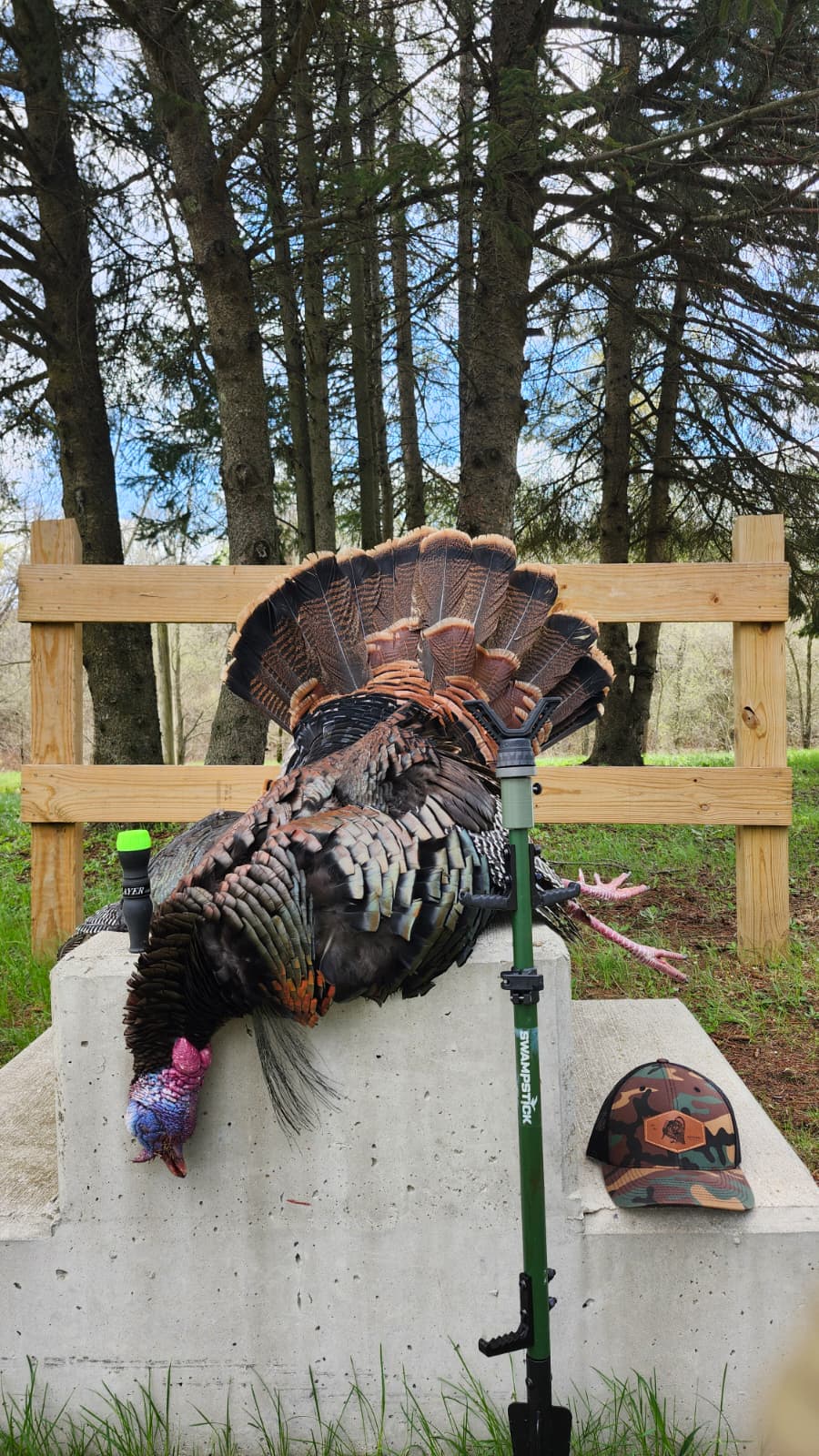
This amazing turkey hunting story was provided by our friends at Swamp Stick. You can check out their amazing products here: Keep hunting gear dry with hunting poles, decoy stands - Swamp Stick Thank you fellas.
There’s something special about spring mornings in Michigan turkey woods. The air carries that sharp chill that hangs on just before sunrise, the woods slowly wake up around you, and every sound feels amplified when you’re waiting for that first gobble.
This hunt started days before opening morning.
After scouting a public land area in South East Michigan for three straight days, I had finally narrowed down a couple of mature toms that were working between two separate fields. Depending on where the hens wanted to be, the birds would shift locations morning to morning. Using OnX to track movement patterns and terrain features, I was able to piece together a game plan before the opener even arrived.
Opening day came with cold rain and tough conditions. The woods were quiet. The hens weren’t vocal, so I kept calling to a minimum. I heard the toms fly down from the roost, but they moved in the opposite direction from my setup. By early afternoon, I took a break to dry out and reset before heading back into the field for an evening sit after the weather cleared.
The birds stayed silent that evening too.
Still, based on the way the morning played out, I had a feeling they’d return to that area to roost before dark. Right at the end of legal shooting hours, I slipped out carefully, already planning the next morning’s move.
Before daylight the following morning, I was back in position.
I reached the field around 5:30 a.m. with the plan to hunt the same edge I had sat the evening before. Instead of rushing into position, I waited for the first gobbles before committing to a setup so I could pinpoint exactly where the birds were roosted.
Then the woods exploded with sound.
To my surprise, one of the toms had roosted in the exact tree I’d been sitting under the night before.
I carefully circled the field in the dim light, keeping low and using the terrain for cover until I reached a small cluster of shrubs near the center. I placed my decoys on a slight rise in the field and crawled back into position to wait.
Given how close the birds were, I expected things to happen fast.
Instead, the toms stayed in the trees gobbling long after sunrise before eventually pitching down into the woods across the field. Public land birds don’t survive long by making mistakes, and pressured toms catch onto hunters quickly. Calling too aggressively can end a hunt before it even starts, so I stayed patient and kept my calling subtle.
At one point, I used a gobble call in hopes of sounding like a challenging young jake moving into the area.
A few moments later, I heard footsteps in the grass directly behind my setup.
Certain one of the toms had circled in silently, I slowly got ready for a shot — only to discover it was a lone hen. She wandered right up to my decoys and made herself completely at home. For the next hour and a half, she fed around the setup, rested in the sunlight, and casually lounged beside the decoys while I stayed frozen in place.
Around 9 a.m., the hen returned once again.
At that point, I started wondering if the morning hunt was slipping away when I noticed movement behind a small hill roughly 45 yards out. Through the brush, I caught sight of a fan slowly moving back and forth behind the crest.
A mature tom had finally shown himself.
I worked a few soft purrs on my slate call, but the bird wouldn’t commit. He strutted behind the brush line, pacing back and forth without giving me a clean shot. Technically, 45 yards was within range for my 12 gauge, but small branches and limited visibility made it a risky attempt.
I decided I’d rather leave with an unfilled tag than force a bad shot.
The tom continued strutting for several minutes while the hen slowly wandered away over the hill. As soon as the bird lost sight of her, I carefully repositioned myself using a Swamp Stick Post-Up 360 to steady my shotgun while staying comfortable in an awkward shooting position.
Then everything changed.
The tom finally rounded the hill and spotted my jake decoy.
Instantly, he puffed up and squared off for a fight.
He strutted, drummed, and began attacking the decoy, kicking it with his spurs and pecking aggressively. Because of the slope of the hill, he kept losing his footing and eventually circled around the decoy to establish dominance from a better angle.
The moment he stretched his neck high to make himself look bigger, I settled in and took the 15-yard shot.
The tom dropped instantly.
I moved carefully toward the bird, shotgun still loaded and ready just in case a follow-up shot was needed, but there was no need. After tagging the bird and gathering my gear, the reality of the hunt finally settled in.
The entire encounter had happened without a single gobble from the tom on the ground.
Sometimes that’s how mature public land birds survive. Silent can absolutely be the name of the game.
After days of scouting, adapting to weather, staying patient, and refusing to rush a shot, the hard work finally paid off. One filled tag, one unforgettable hunt, and another reminder that success in the turkey woods usually belongs to the hunters willing to stay patient when things don’t go according to plan.


